
Holiday shoppers are watching every dollar this year, and more of their budgets are already spent before the season peaks. Deloitte expects 28% of shoppers’ holiday budgets to be exhausted by the end of October, the highest share in six years, and 38% of shoppers are value seekers who shop promotions and look to private label. In a season like that, holiday CTV advertising can’t coast on what worked last year. You have to be in front of shoppers while they’re paying attention and deciding where their dollars go.
Shoppers are tightening up
The headline numbers look healthy. The National Retail Federation expects holiday sales from November 1 through December 31 to rise 4.2% to $1.013 trillion, and Deloitte expects the average household to spend $1,654, up 4% from last year. The detail underneath is more cautious.
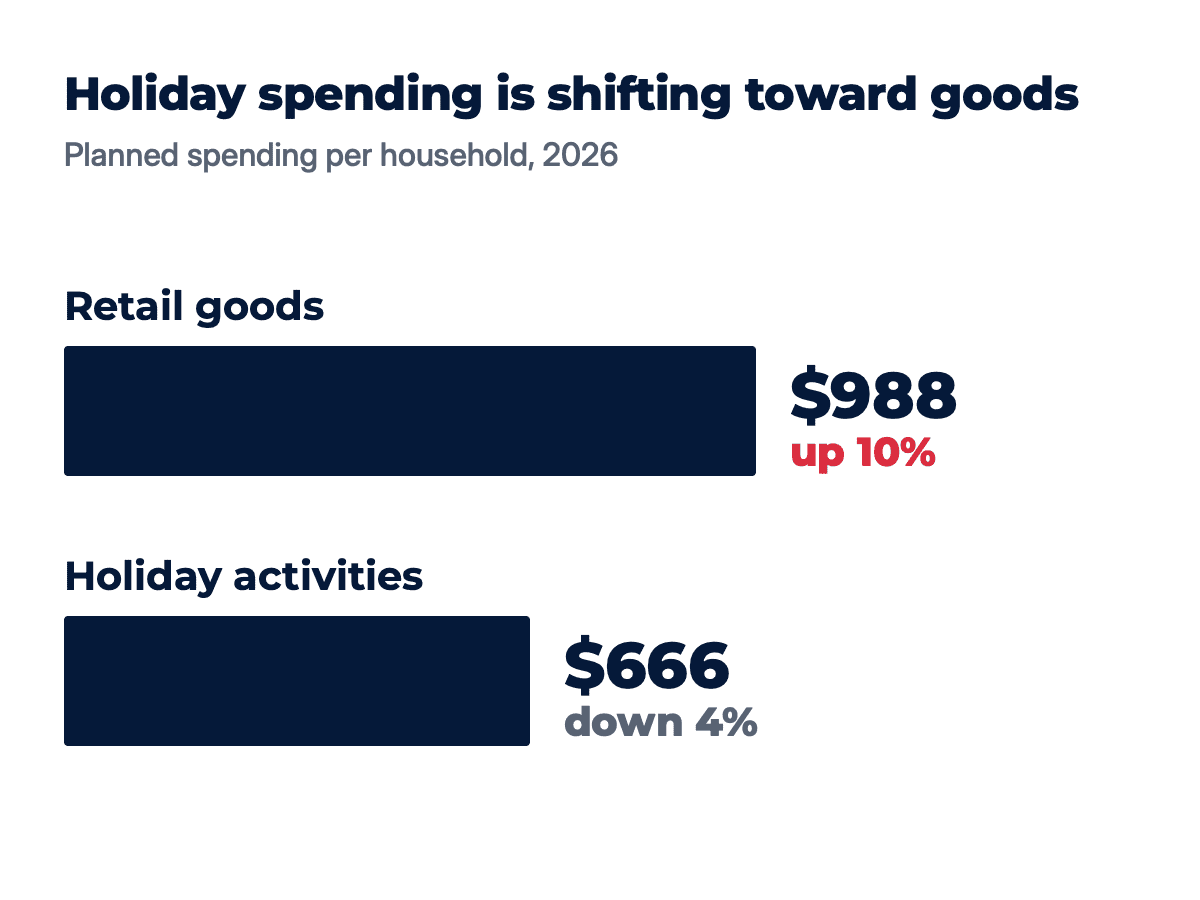
Deloitte found that planned spending on retail goods is up 10% to $988, while planned spending on holiday activities is down 4% to $666. One in four shoppers already bought holiday items during June promotional events, and roughly four in ten plan to shop October sales events. Price and value remain the top factor in choosing a retailer.
NRF’s October survey, run by Prosper Insights & Analytics with 8,094 US adults, points the same way. 56% said economic conditions will influence their spending. Among those shoppers, 43% plan to seek out sales more often, 31% to compare prices online more often and 29% to use coupons more regularly.
Drive Research found that 71% of holiday shoppers say Black Friday and Cyber Monday deals aren’t as good as they used to be, and planned Cyber Monday shopping is down to 61% from 68% in 2024. Shoppers who doubt the deals are harder to win over, so every ad has to give them a reason to act.
Those value seekers still expect to spend 12% more than other shoppers, according to Deloitte. So show what the deal is worth: what comes in the bundle, what the shopper saves, or what they get at a purchase threshold.
When holiday shoppers start buying
The season starts early. In NRF’s October survey, 43% of shoppers planned to start before November, and 64% were likely to do most of their holiday shopping over Thanksgiving weekend. In a June 2026 Attentive survey of 600 US adults who plan to shop Black Friday and Cyber Monday sales, 71% said they plan to start buying before Black Friday and 46% before November. Those respondents already get brand email or text, so they are more engaged than the average shopper.
The takeaway for CTV is timing. If Thanksgiving weekend is still ahead of you, the biggest shopping days are still to come, and December follows them. Plan a different message for each phase instead of one big push that week.
Be in front of shoppers while they’re paying attention
Streaming made up 49.6% of US TV viewing time in August 2026, according to Nielsen, more than cable at 18.9% or broadcast at 17.5%. That makes streaming a place to reach shoppers early in the season, before more of their budgets are spent. Last year’s channel mix may not be enough to carry this season on its own.
Streaming doesn’t reach everyone. Pew Research found in 2025 that 83% of US adults watch streaming services, and 64% of adults 65 and older still subscribe to cable or satellite. If your best customers skew older, plan to reach them in more than one place. For how the two compare, read our post on CTV vs linear TV. We also buy programmatic linear TV, which reaches 30 million address-verified households.
Plan holiday CTV advertising around four kinds of shoppers
These four groups are a planning framework, not survey segments. Each one needs different creative and a different amount of exposure. Start broad with brand awareness, then get more targeted with each phase.

Before Black Friday:
The planners
They shop early and compare before they buy. This is the time for brand awareness: get in front of your best-fit households with creative that shows who you are and why you’re worth the price, so they already know you when the deals start.

Black Friday and Cyber Week:
The frugal shoppers
They’re checking every deal. Get more targeted: put the real price and the end date in the ad, and retarget site visitors with a version that goes straight to the offer, on CTV and in streaming audio.

Early December:
The gift finishers
They want gift ideas, not another sale. Pull the sale creative the day it ends and narrow in on what sold: show your Black Friday best sellers as gift bundles with the savings and a delivery date.

Mid to late December:
The procrastinators
They’re out of time, so the deadline is the message. Put the last shipping date in the ad and change it as each cutoff passes, then switch to in-store pickup or digital gift cards when delivery is no longer possible.
Shoppers who visit your site and leave are the easiest to win back. We retarget site visitors on CTV and in streaming audio through RIVI, so the same shopper sees your ad on the TV and hears it while they stream music or podcasts.
Spend your frequency where it pays
Setting every campaign to the same frequency and walking away wastes budget when shoppers have less to spend. Each of those shoppers needs a different amount of repetition, and the right amount changes as the season moves. GammaRay, our bidder, governs frequency at the household level across CTV, streaming audio and display, so one household does not get hit fifteen times in a weekend.
Then check the result. Look at how many households saw your ad once or twice and how many saw it fifteen times or more. If a small group of households is getting most of the repeat exposure, revisit the household cap and put more of the budget into reaching households that haven’t seen the ad yet. For the math, see how to calculate reach and frequency. For the full frequency playbook, read our post on CTV ad frequency.
Watch the hours and the apps
Ask for delivery by hour, publisher and app, then move budget toward the windows and the publishers that produce results. GammaBurst shows delivery, publishers, frequency and conversions in one place, so you can make that call while the season is still running.
Where your ad runs matters too. We buy directly from publishers, and Hard Check blocks more than 250 million invalid impressions a month before they count against your spend.
Measure what your holiday campaign produced
Judge holiday CTV advertising by what happened after the ad, not by impressions. Track purchases, revenue and ROAS first, then website visits, form fills and phone calls. Publisher and app reporting shows where the spend went and which placements received credit. We credit results across every streaming publisher that helped, through fractional attribution, and phone calls come through our CallRail integration.
For what to ask your provider for and how to read the results, see our guide to CTV measurement.
Holiday CTV advertising FAQ
When should holiday CTV advertising start?
As early as you can. In NRF’s October survey, 43% of shoppers planned to start before November, and Deloitte expects 28% of shoppers’ holiday budgets to be exhausted by the end of October. If you are starting now, Thanksgiving weekend is still ahead: 64% of shoppers were likely to do most of their holiday shopping then. Plan a season-long schedule with a different message for each phase.
Are holiday shoppers cutting back in 2026?
Many are watching spending closely. Deloitte found that 38% of shoppers are value seekers who shop promotions and look to private label, and in NRF’s October survey 56% said economic conditions will influence their spending. Total spending is still expected to grow.
What should I run after Cyber Monday?
Swap expired sale creative for gift bundles, best sellers and a clear delivery promise in early December. As shipping deadlines pass, switch to in-store pickup or digital gift cards.
Is Cyber Monday still worth planning for?
Yes, as one part of a longer season. Drive Research found 61% of holiday shoppers plan to shop Cyber Monday, down from 68% in 2024, while 69% plan to shop Black Friday deals online.
How should I measure holiday CTV results?
Track purchases, revenue and ROAS first, then website visits, form fills and phone calls, credited to the publishers and apps that contributed. Impressions alone don’t show whether holiday shoppers acted.
Need to decide where to put the rest of your holiday streaming budget? Book a strategy call and we’ll look at who you still need to reach and what you can run before your shipping cutoff.