So, how much does a 30-second local TV ad cost? It can run hundreds or thousands of dollars each time it airs. Published 2025 estimates range from $200 to $1,500 in smaller markets and $2,000 to $10,000 in larger ones, with some top-market spots costing considerably more. These are planning estimates, not station quotes.
But the price of the spot answers only part of the question. How many people will it reach? How many could actually become customers? And could streaming reach those households more efficiently?
Here’s how to compare the costs.
How much does a 30-second local TV ad cost by market size?
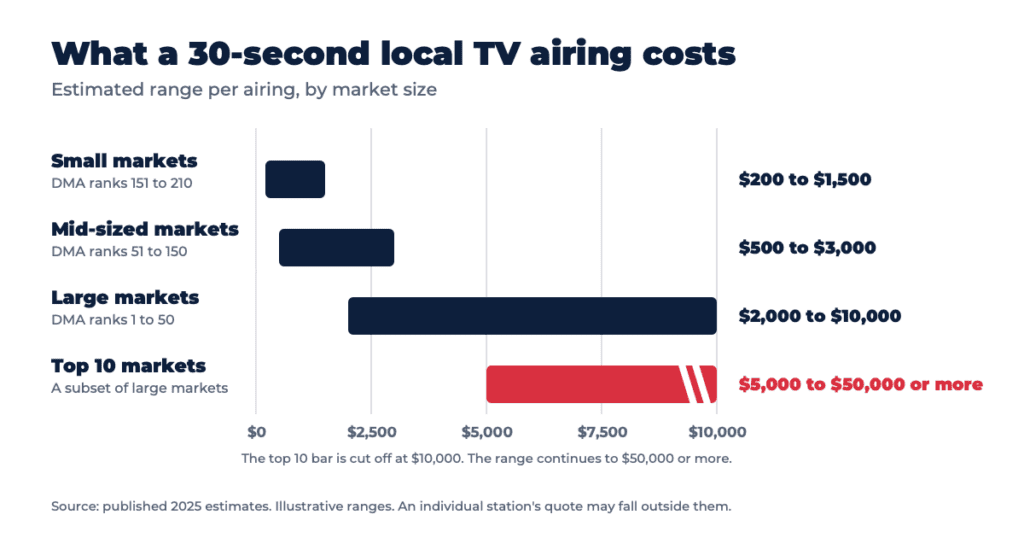
Market size is one of the biggest factors in the price of a local broadcast spot. Published 2025 estimates put the typical ranges like this:
| Market category | Estimated cost per 30-second airing |
|---|---|
| Small markets, DMA ranks 151 to 210 | $200 to $1,500 |
| Mid-sized markets, DMA ranks 51 to 150 | $500 to $3,000 |
| Large markets, DMA ranks 1 to 50 | $2,000 to $10,000 |
| Top 10 markets | $5,000 to $50,000 or more |
Source: Published 2025 estimates. The top 10 are a subset of the large-market category. These ranges are illustrative, and an individual station’s quote may fall outside them.
A DMA, or designated market area, is a geographic television market. Nielsen describes DMAs as non-overlapping regions that group counties based on television viewing areas, and there are 210 of them in the United States.
What changes the price of a local TV spot
The market gets you only part of the way to a price. The program, audience size, time of day, season and length of the commercial also affect what you’ll pay. High-demand programming can command a premium.
Time of day moves the price a lot. Published estimates list late night and daytime as the cheapest slots and prime time as the most expensive:
| Time of day | Estimated cost per 30-second airing |
|---|---|
| Late night (11 PM to 2 AM) | $200 to $1,000 |
| Daytime (9 AM to 4 PM) | $300 to $1,500 |
| Early morning (6 to 9 AM) | $500 to $2,500 |
| Early fringe (4 to 7 PM) | $800 to $3,500 |
| Prime time (7 to 11 PM) | $2,000 to $50,000 or more |
Source: Published estimates. These ranges aren’t tied to a specific market size, so use them to compare time slots, not to predict your quote.
When you request a quote, ask for the schedule behind it:
- Which stations and programs will carry the ad?
- How many times will it air, and when?
- What audience is the station estimating?
- How much of that audience fits your target customer?
- What happens if the schedule changes or delivery falls short?
- Which fees and services are included?
A price per spot is useful. A price attached to a clear schedule and audience estimate is much more useful.
A $1,000 spot doesn’t buy $1,000 worth of potential customers
Say you pay $1,000 for a local news spot. You picked the program because you expect your customers to be watching. But how much of its audience actually fits?
Here’s a hypothetical example. Your spot reaches an estimated 20,000 viewers, which works out to a $50 CPM, or cost per thousand viewers. If your campaign targets men and only half those viewers are men, you’ve reached 10,000 target viewers. Your cost per thousand target viewers is now $100.
| Same $1,000 spot | Estimated audience | Cost per thousand |
|---|---|---|
| All viewers | 20,000 | $50 |
| Viewers who fit your target | 10,000 | $100 |
That’s before considering whether they live within your service area or are likely to need what you sell.
Local broadcast advertisers can choose programs that attract more of their intended audience. But a conventional spot still appears to the audience watching that airing, including people outside the advertiser’s target. Linear audience measurement estimates viewership using panels and other viewing data.
This doesn’t mean every TV buy works the same way. Programmatic linear TV is bought on CPM, the same way streaming is, so you can compare the two on one measure. Our programmatic linear reaches 30 million address-verified households and 100 million authenticated adults, so you choose who sees the ad instead of buying a time slot and hoping. Ask which type of inventory your proposal includes.
The useful comparison is what you pay to reach the people who could become customers.
Streaming TV can be local, too
Your customers might be watching a national streaming service, but your advertising can stay local.
Connected TV advertising, or CTV, puts streaming video ads on internet-connected televisions. Streaming video also plays on phones and computers, which is a different placement and can be priced differently. Neither is wrong, but a TV in the living room is not the same as a phone in someone’s hand, so confirm which devices your campaign includes and compare prices like for like.
CTV platforms can target selected ZIP codes or markets, then apply audience criteria within those locations. Depending on the provider, you can also reach matched customers from your own list or retarget people who visited your website. Available targeting varies by platform and campaign category.
For a business serving a handful of ZIP codes, that changes how you plan the buy. Start with the area you serve and the households you want to reach. Then build a budget around reaching those households across available streaming inventory.
It’s a familiar approach if you already buy social advertising: define the audience, set the geography, and decide what you’re willing to spend. The ad appears on their television.
How much does CTV advertising cost?
CTV advertising is commonly priced by CPM, the cost per thousand ad impressions.
For a published pricing reference, Paramount Ads Manager’s 2026 pricing guide lists $20 to $40 CPM for standard inventory and $40 to $60 CPM for premium, highly targeted placements. eMarketer, puts the blended average U.S. CTV CPM at about $26, with most campaigns between $25 and $35. These are estimates from publishers and benchmark sites, rather than an independently measured industry average or our quote. Actual prices can fall outside those ranges.
Here’s how different CPMs translate into impressions:
| Media budget | At a $20 CPM | At a $30 CPM | At a $40 CPM |
|---|---|---|---|
| $1,000 | 50,000 | 33,333 | 25,000 |
| $2,500 | 125,000 | 83,333 | 62,500 |
| $5,000 | 250,000 | 166,667 | 125,000 |
These calculations assume the full budget buys media. Production and any separately charged platform, data or management fees would be additional.
Impressions include repeat exposures. For example, 125,000 household impressions at an average frequency of five would represent about 25,000 unique households. That calculation assumes impressions and frequency are both measured at the household level. Our post on how to calculate reach and frequency walks through the math.
A delivered impression also doesn’t prove someone paid attention, and impressions can be counted at different points in delivery, so a publisher’s count and an advertiser’s can differ, according to IAB’s guide to video impressions. Ask how your provider measures delivery and verifies inventory quality.
Is streaming TV cheaper than local broadcast TV?
It can be, but a lower CPM alone won’t tell you which buy is better, and neither will how much a 30-second local TV ad costs.
Streaming lets you concentrate a campaign on selected locations and audience criteria. More specific targeting can increase the CPM, so a smaller audience doesn’t automatically mean a lower price per impression.
The question is whether that added precision improves the cost of reaching potential customers.
If half a broadcast spot’s audience falls outside your target, a higher-priced streaming impression could still be more efficient. It depends on the actual audience match, delivery and fees.
When comparing proposals, look at:
- Estimated reach within your service area and target audience.
- Average frequency over the same campaign period.
- Where the ads will run and on which devices.
- Whether audience figures count people, households or devices.
- Total cost, including separately charged fees.
That gives you a clearer comparison than putting a broadcast spot price next to a streaming CPM.
How much does a Super Bowl ad cost?
At the national end of the scale, NBCUniversal reported a record price of more than $10 million for a 30-second Super Bowl LX commercial in February 2026. That was a record price, rather than a standard rate for every advertiser.
Nielsen’s final average audience for the game was 125.6 million viewers across NBC, Peacock, Telemundo, NBC Sports Digital and NFL+. At $10 million, that works out to roughly $80 for every thousand viewers (our math: $10 million divided by 125.6 million, times 1,000), for an audience that includes everyone who tuned in, whether or not they’re anyone’s customer.
It’s an exceptional event with exceptional pricing. A local business can build a television campaign around a much smaller geographic audience. For most local businesses, the question is still what a 30-second local TV ad costs in their own market.
Does the price include making the ad?
The figures in this article cover media placement only.
When comparing proposals, ask whether production, editing, platform fees, data fees and campaign management are included or charged separately. Your media budget and total campaign cost may be different.
Common questions about TV ad costs
How much does a 30-second local TV ad cost?
There’s no single rate. Published 2025 estimates put a small-market local spot at $200 to $1,500 per airing, with larger markets costing more. Your actual quote depends on the station, programming, schedule and demand.
How much does local TV advertising cost?
It depends on the market, the time of day and the season. Published 2025 estimates run from about $200 per airing to $50,000 or more.
How much does a Super Bowl ad cost?
For Super Bowl LX in 2026, NBCUniversal reported a record price of more than $10 million for a 30-second spot.
Can streaming TV ads target my local area?
Yes. Platforms can offer geographic targeting such as ZIP codes and DMAs, with additional audience options depending on the provider and campaign category. You don’t have to buy a national audience to advertise on a national streaming service.
How much should I budget for CTV advertising?
Start with the households you want to reach and how often you want to reach them. Multiply household reach by average household frequency to estimate the impressions needed. Divide by 1,000, multiply by the proposed CPM, and add any separately charged fees.
Is a cheaper TV spot always a better deal?
No. A cheaper airing can still cost more per potential customer if much of its audience falls outside your target. Compare audience fit, reach, frequency and total cost.
Want to see what your budget could achieve with the households you’re trying to reach? Tell us who they are and we’ll map it. Book a strategy call.