TV used to come in two sizes. You could buy your local station, like a home services company advertising on the local news, or you could go national. If your brand fell somewhere in between, it was hard to know whether TV was for you at all. Streaming changes that, because now you can choose who sees your ad and where. Both CTV and linear TV put your ad on a television, so it’s fair to wonder why anyone treats them as different buys. The difference is how you decide who sees the ad, what you can measure afterward and what you pay for the viewers you actually want. This guide compares CTV vs linear TV on those three points, so you can decide where your budget belongs.
CTV stands for connected TV. It’s streaming TV advertising: ads that play in the ad breaks of streaming apps on a television connected to the internet. Linear TV is traditional television that airs on a set schedule, on broadcast networks and cable channels.
CTV vs linear TV at a glance
Here’s how the two compare for a typical advertiser.
| Compared on | Conventional linear TV | CTV |
|---|---|---|
| How you buy | By program, time slot and market | By audience and household |
| Who sees your ad | Everyone watching that airing | The households you choose |
| How often they see it | Builds with every airing | Can be capped per household |
| What you see afterward | Audience estimates from panels and other viewing data | Impressions and completions by publisher and app |
| Price per thousand viewers | National primetime averages run from about $18 to $42, and local prices differ | Published prices run from about $20 to $60, and we’ve seen buyers charged even more |
Prices vary with the network, the program, the audience and how targeted the buy is. Sources: Media Dynamics and Paramount Ads Manager. Our post on how much a 30-second local TV ad costs covers local prices.
Where the audience is now
People watch TV without thinking about how it reaches the screen. Some of what they watch comes through traditional channels and some through streaming, and the lines between them are blurring, because a lot of content runs on both and some of it is exclusive to one. In July 2026, Nielsen reported that streaming made up 49.0% of all TV time, with broadcast at 19.5% and cable at 18.7%.
What you can buy depends on who you’re trying to reach. Among adults 18 to 49, streaming is 66.7% of ad-supported TV time and linear is 33.4%, as reported by Señal News from Nielsen’s 2026 Upfront Planning Guide. Across all viewers, linear is still about half.
Budgets haven’t caught up with where people watch. eMarketer’s July 2026 analysis puts all TV, meaning streaming plus cable, at 38.0% of the time people spend with media but only 18.0% of US ad dollars.
Connected TV vs linear TV: which costs less?
This is where it gets interesting. National primetime averages for linear TV run from about $18 per thousand viewers on cable to about $42 on broadcast networks, and published CTV prices run from about $20 to $60, and we’ve seen buyers charged even more. The ranges overlap, so the price per thousand viewers can’t settle the question on its own.
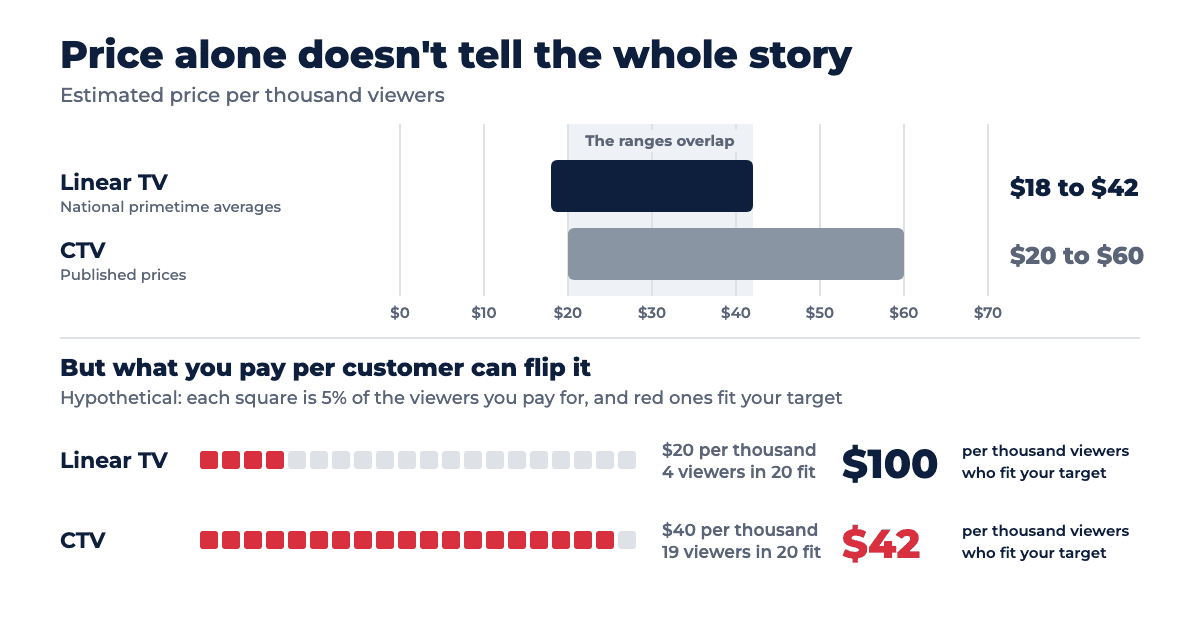
Cheaper per thousand isn’t the same as cheaper per customer. Conventional linear TV charges you for everyone watching that airing, and you’re hoping your customers are among them. Here’s a hypothetical: at a $20 cost per thousand, if only one viewer in five fits your target, you’re paying about $100 per thousand viewers who matter. With CTV you choose the households, so a higher price per thousand can still reach the people you want for less. Our post on how to calculate reach and frequency shows how to check the math for your own plan.
Where linear TV still makes sense
Linear TV is still where a huge share of ad-supported viewing happens, and where live sports, news and big events gather large audiences at the same moment. Nielsen credited sports, including the NBA playoffs and early World Cup coverage, for broadcast’s gain in the second quarter of 2026.
Its audience also skews older. In Pew Research Center’s April 2025 survey, 64% of adults 65 and older said they subscribe to cable or satellite TV, compared with 44% of adults 50 to 64, 23% of adults 30 to 49 and 16% of adults 18 to 29. If your customers skew older, linear is worth a serious look.
Linear also suits advertisers whose customers really are almost everyone. Insurance is the classic example: nearly every household needs it, so broad reach makes sense. Most advertisers aren’t in that position. If your target market is everyone, your target market is no one, and buying the whole market means paying for a lot of viewers who will never buy.
Where CTV is the better choice
CTV advertising tends to win when any of these is true:
- You know the persona of who you want to reach, and you want to start with those households.
- You want to cap how often each household sees you, so budget isn’t spent on excessive repeats.
- You want to know which apps delivered while the campaign is still running.
- You want to run in a small area, such as a handful of ZIP codes.
Programmatic linear TV: target the part of linear that fits
Linear TV is also evolving. There are newer offerings that allow you to buy linear TV with targeting similar to streaming. We run programmatic linear TV, bought on CPM like streaming, so you can aim real cable TV at the households that fit your customer instead of buying a whole time slot. It reaches 30 million address-verified households and 100 million authenticated adults, and because linear now has similar capabilities to streaming, you can target it and measure it in much the same way.
How to decide
Pick by who you need to reach, not by screen. Start with three questions:
- Who exactly do you need to reach? If it’s a specific audience or area, CTV or programmatic linear lets you start there. If it’s almost everyone or skews older, broad linear can make sense.
- What do you need the ad to do? If you want broad reach at a live moment, such as sports or a big event, linear fits. If you want to target households and measure what happens next, CTV and programmatic linear both let you do that.
- How much of your budget can go to people who will never buy? Conventional linear charges you for everyone watching. CTV and programmatic linear let you start with the households you want and cap how often each one sees you.
There is no right or wrong answer here, because it depends on your audience and what you’re trying to achieve. The lines keep blurring, with live events crossing over into streaming, and there is still a lot of attention on linear. Linear now has programmatic targeting too, which gives you another way to make it more performance driven.
Running a law firm campaign? We compare the two for that case in Mass Tort Marketing: Linear TV vs Streaming for Law Firms and What Broadcast TV’s Targeting Problem Is Costing Your Firm.
Not sure which fits? Tell us who you’re trying to reach and we’ll map it. Book a strategy call.
Common questions about CTV vs linear TV
Is CTV better than linear TV?
Neither wins every time. CTV is stronger for precise audiences, household frequency caps and app-level reporting. Linear TV still gathers big live audiences and skews older. The right answer depends on your audience and what you’re trying to achieve.
Is CTV cheaper than linear TV?
It depends on what you buy. National primetime linear averages run from about $18 to $42 per thousand viewers, and published CTV prices run from about $20 to $60, so the ranges overlap. The bigger question is how many of those viewers are your customers, because with linear you’re paying for everyone watching and hoping yours are among them. Local prices differ.
Who still watches linear TV?
Linear’s audience skews older. In Pew’s April 2025 survey, 64% of adults 65 and older subscribe to cable or satellite TV, compared with 16% of adults 18 to 29. Across all viewers, linear is still about half of ad-supported TV time, according to Nielsen.
Can I run CTV and linear TV in the same campaign?
Yes. Programmatic linear TV is bought on CPM like streaming, so you can compare the two and plan them together.
What does CTV stand for?
CTV stands for connected TV, which is a television connected to the internet. Our CTV advertising page explains how it works.