PI Law Firm Advertising Costs Are Rising. Why Your Budgets are Up, But Your Caseload is Down
If you run marketing for a personal injury law firm, you know the feeling. Every year, the budget conversations with senior partners get tougher and tougher. Costs go up. Lead volume stays flat or drops. And when someone asks what you are getting for the spend, the honest answer is… it’s complicated.
You are not alone.
PI law firm advertising costs have been climbing for years, and the dynamics behind that increase are worth understanding before you propose next quarter’s media plan.
The Scale of the Problem: What PI Firms Are Actually Spending
Legal advertising in the U.S. is now a massive industry. According to the American Tort Reform Association’s 2024 Legal Services Advertising Report, total legal services ad spend exceeded $2.5 billion in 2024, up 39% from 2020. The largest single spender was Morgan and Morgan, which accounted for an estimated $218 million in advertising that year alone.
For mid-size PI firms, the dollar amount is smaller but the pressure is proportional. According to Conroy Creative Counsel, larger firms handling competitive practice areas like personal injury typically invest $150,000 or more per year on marketing, with aggressive growth firms allocating 10% or more of gross revenue to advertising.
Those numbers would be easier to justify if the return on that spend were improving. The problem is that it is not, at least not in the traditional channels where most of that money still goes.
Why Google Ads Keeps Getting More Expensive for PI Firms
Google Ads is where most PI firms look first for measurable lead generation, and it remains a powerful channel when managed well. But the economics have shifted dramatically.
Personal injury is now consistently one of, if not the, most expensive verticals in all of Google advertising.
Keywords like ‘car accident lawyer’ routinely exceed $150 per click in competitive markets. ‘Truck accident attorney’ can push $300. In major metros including Los Angeles, Chicago, and Miami, top personal injury terms regularly exceed $500 per click, according to Rankings.io’s analysis of Google Ads performance for personal injury law firms.
The cost per lead paints an even starker picture. According to LocaliQ’s 2024 legal search advertising benchmarks, accidents and personal injury law had the highest cost per lead of any legal practice area, averaging $159. But that figure reflects averages across markets and campaign types.
In competitive metros, firms regularly see cost per lead figures of $700 to $1,500.
Why are costs climbing so fast? Because every competing PI firm in your market is bidding on the same high-intent keywords. The auction gets more crowded every year. The floor rises. And the firms with the deepest pockets can absorb cost increases that put smaller firms in an unsustainable position.
Why Meta Ads Aren’t the PI Law Marketing Shortcut They Look Like
It’s not just Google ads. When “car accident lawyer” exceeds $150 per click and top terms in Los Angeles, Chicago, and Miami regularly push past $500, according to Rankings.io’s analysis of Google Ads performance for personal injury law firms, Meta seems to be an obvious choice. After all, CPCs on Facebook are a fraction of what they are on Google.
But those numbers are telling you something different than you think.
The core problem is intent. Google captures people who have already decided they need a lawyer. According to INSIDEA’s 2025 analysis of Facebook advertising for personal injury lawyers, Meta intercepts prospects while they’re passively scrolling their feed, before they’ve decided they need anything.
You’re not getting a discount on high-intent leads. You’re reaching a different person at a different moment.
The bigger trap is attribution. Meta’s default 7-day click and 1-day view attribution window means it claims full credit for a conversion even when other channels did the actual work, according to EasyInsights’ analysis of Meta Ads over-reporting.
A prospect sees your Meta ad, doesn’t engage, then searches “car accident attorney [city]” on Google days later and calls your firm. Meta reports the conversion. You shift more budget away from Google. Intake volume quietly drops.
As My Legal Academy’s law firm attribution guide puts it, if you cut Google Ads because Meta appears to convert better, you may find that Meta has no one left to retarget. Meta builds recognition. Google captures intent. Treating Meta as a direct-response channel because your dashboard says so is making budget decisions on numbers that don’t reflect reality.
Wasted Impressions in Broadcast Television
Traditional media spending in legal advertising is surprisingly still growing. According to ATRA’s March 2025 report, spending on legal services advertising increased approximately 39% between 2020 and 2024, with total estimated spend exceeding $2.5 billion, more than double what pizza restaurants spent on advertising in the same period.
But that spending is not evenly distributed. Broadcast television is increasingly a channel for firms operating at a scale most PI practices will never reach. Morgan and Morgan alone spent an estimated $218 million on advertising in 2024, accounting for 8% of all legal services ads in the country.
For the firms below that tier, buying enough television to matter against that kind of presence is a pipe dream.
Radio is the more realistic traditional channel for most PI firms. Radio ads for legal services peaked in 2024 with more than 6.8 million spots, a 261% increase compared to 2017, with spending on those ads up 134% over the same period.
But radio carries the same structural problem as television: you are buying mass reach and hoping that the small percentage of listeners who are relevant to your practice hear the ad enough times to remember your name when they actually need you.
There’s no targeting, no intent signal, and no way to know whether the person who eventually calls heard your ad once or fifty times.
Both channels build awareness. Neither tells you who is listening, whether they need a lawyer, or whether your spend is what made the phone ring.
Both channels build awareness for the portion of the market still tuned in… yet that portion is shrinking. A significant share of your potential clients are not watching local news and are not listening to AM radio anymore. They have moved to streaming. Additionally, neither broadcast nor radio tells you who is listening, whether they need a lawyer, or whether your spend is what made the phone ring.
And they can no longer claim to reach the whole room.
The Deeper Issue: PI Law Firm Ad Spend Is Structurally Inefficient
The real problem with PI law firm advertising costs is not any single channel. It is the model. Most PI firms are spending heavily on demand capture: reaching people who are already searching for a lawyer.
Google Ads is the clearest example. When someone types “car accident lawyer near me,” they have already decided they need legal help. The question is only which firm they call.
Demand capture is expensive precisely because every firm in your market is competing for the same narrow window of high-intent traffic. And it captures only a fraction of the potential clients who will eventually need your services.
According to Martindale-Nolo’s 2024 research cited by Andava, PI firms need an average of 13.4 leads to convert one new client across all practice areas.
At a cost per lead of $700 to $1,500 in competitive markets, that translates to a cost of acquisition that makes demand capture alone an unsustainable growth strategy for most firms.
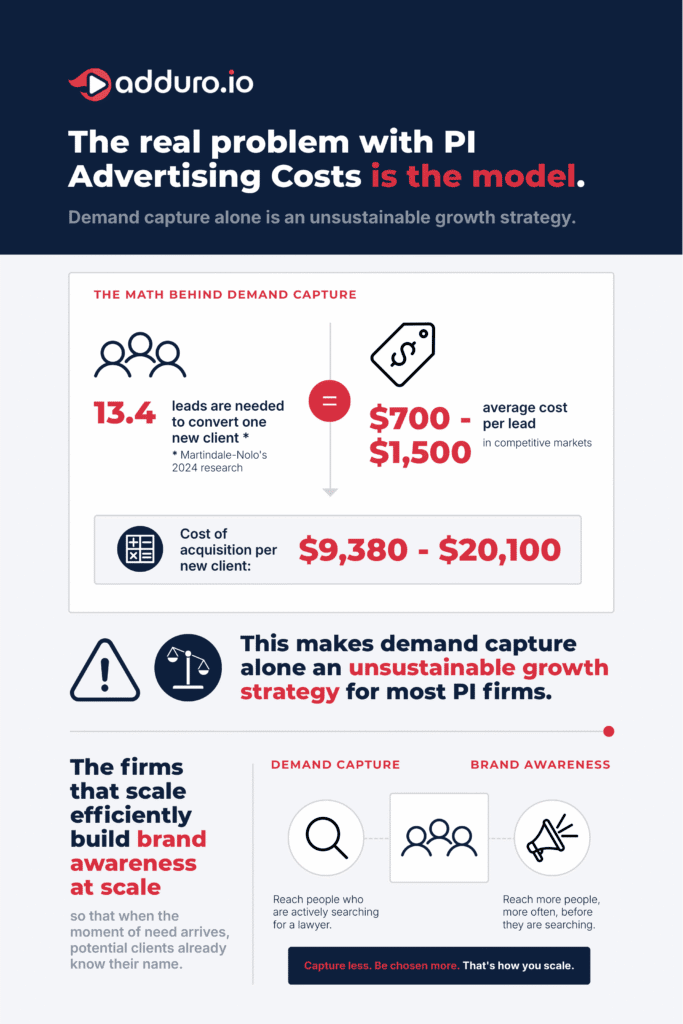
The firms that are scaling efficiently are not abandoning Google or digital entirely. But they are building brand awareness at scale alongside their demand capture spend, so that when the moment of need arrives, potential clients already know their name.
What Growing PI Firms Are Doing Differently
The firms winning market share in the most competitive DMAs have moved beyond a channel-by-channel bidding strategy. They are thinking about media holistically: which channels build brand recognition over time, and which channels convert that recognition into signed cases.
For most of legal advertising history, that brand-building question had one answer: television.
But broadcast television was only accessible at scale to firms with budgets large enough to sustain a market presence. The structural problem was not just cost; it was that the audience was never targetable. You bought a DMA and hoped the right households were watching.
Connected TV Has Opened The Door Broadcast Kept Closed
According to Nielsen’s monthly Gauge report, streaming represented 44.8% of total TV viewership in May 2025, surpassing the combined share of broadcast and cable for the first time ever. Connected TV platforms, including Hulu, Roku, Peacock, and YouTube TV, carry that audience now.
And unlike broadcast, they allow streaming advertisers to target by geography, demographics, and behavioral signals, including users who have recently searched for legal terms or visited legal advice websites, according to KJ Strategy Group’s analysis of CTV for personal injury law firms.
CTV typically runs $20 to $40 CPM, putting TV-style brand presence within reach for firms that could never sustain a traditional broadcast media buy.
Streaming Audio Is Doing The Same Thing To Radio
Spotify reaches approximately 90 million ad-supported listeners who stream an average of two hours daily, with a reported 24% lift in ad recall for audio advertising. Pandora and SiriusXM offer similar reach with geographic and demographic targeting that terrestrial radio cannot match. For firms that have relied on radio to build local name recognition, streaming audio delivers the same format with far less wasted spend.
Brand-building at scale no longer requires a broadcast budget. It requires showing up consistently, in the right format, in front of the right households.
The audience has moved. And the best PI law firm marketing strategies are following it.
Sources
1. American Tort Reform Association. Legal Services Advertising in the United States, 2020-2024. March 2025. https://www.atra.org/wp-content/uploads/2025/03/Legal-Services-Advertising-Report-%E2%80%93-2017-2024.pdf
2. Conroy Creative Counsel. How Much Do Law Firms Spend on Marketing. https://conroycreativecounsel.com/how-much-do-law-firms-spend-on-marketing/
3. Rankings.io. Google Ads Quality Score for Personal Injury Lawyers. https://rankings.io/blog/google-ads-quality-score-personal-injury-lawyers/
4. INSIDEA. 12 Facebook Ad Strategies for Personal Injury Lawyers. February 2026. https://insidea.com/blog/marketing/personal-injury-lawyers/facebook-ad-strategies/
5. EasyInsights. How to Fix Over-Reporting in Meta. July 2025. https://easyinsights.ai/blog/fix-over-reporting-in-meta/
6. My Legal Academy. Marketing Attribution for Law Firms: Track What Drives Signed Cases. February 2026. https://mylegalacademy.com/kb/law-firm-marketing-attribution-tracking-guide/
7. LocaliQ. Legal Search Advertising Benchmarks for 2024. https://localiq.com/blog/legal-search-advertising-benchmarks/
8. Legal Leads Group / Lucrative Legal. How Much Do Personal Injury Attorneys Spend on Google Ads. https://lucrativelegal.com/how-much-do-personal-injury-attorneys-spend-on-google-ads/
9. Eskimi. Connected TV Statistics and Trends. https://www.eskimi.com/blog/ctv-statistics-and-trends
10. Nielsen. Connected TV Is Transforming Advertising. May 2025. https://www.nielsen.com/insights/2025/connected-tv-transforming-advertising-trends/
11. Andava. 130+ Legal Marketing Statistics for 2025. https://www.andava.com/learn/legal-marketing-statistics/
12. Nielsen. Streaming Reaches Historic TV Milestone, Eclipses Combined Broadcast and Cable Viewing For First Time. June 2025. https://www.nielsen.com/news-center/2025/streaming-reaches-historic-tv-milestone-eclipses-combined-broadcast-and-cable-viewing-for-first-time/
13. KJ Strategy Group. Why Personal Injury Law Firms Should Invest in Connected TV. March 2026. https://kjstrategygroup.com/blog/connected-tv-for-personal-injury-law-firms-a-complete-guide/
14. Taqtics. What is CTV Advertising? Complete Guide for Law Firms. March 2026. https://taqtics.com/answers/ctv-advertising/what-is-ctv-advertising/
15. Zero Gravity Marketing. Advertising on Spotify and Pandora. May 2025. https://zerogravitymarketing.com/blog/advertising-on-spotify-and-pandora/