
Mass tort advertising is one of the most expensive and competitive categories in legal marketing. In 2024, law firms spent $1.2 billion on mass tort TV advertising, with 16.4 million ads running across broadcast and streaming channels.
With that much money in the market and qualification criteria that most viewers will never meet, the question is not whether you can afford to advertise. It is whether you can afford to reach the wrong people.
A lot of marketing departments are framing this as linear TV (which includes both broadcast & cable) versus streaming. That framing is not quite right. The better question is: given what you know about your claimant population, where are they actually watching?
As of January 2026, streaming accounts for 47% of total TV viewing time while broadcast and cable together account for roughly 43%.
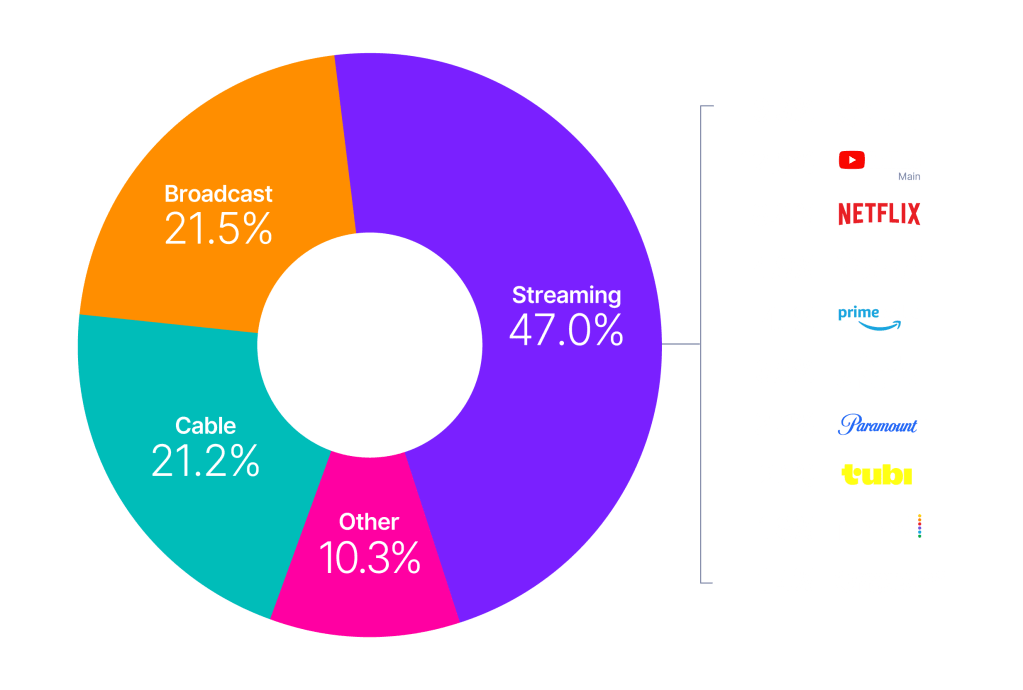
The Gauge, Nielsen
The audience is nearly split, and your ad strategy should reflect that, with one important caveat: your specific claimant population may not mirror the national average.
What Linear TV Does Well
Linear TV may no longer command the majority of viewing time, but for the right claimant population it remains the most efficient way to build awareness at scale. For mass tort campaigns where that population skews older, such as pharmaceutical cases tied to drugs used over many years or environmental exposure cases from decades past, broadcast reach is not just useful. It is often essential.
Linear builds awareness quickly, which matters when you are working against a statute of limitations and need volume fast. The tradeoff is that linear targeting stops at the channel and the show. You can choose programming that tends to skew toward your demographic, but you cannot filter who actually sees the ad. Your message runs to everyone in that time slot, and the majority of those viewers will not meet your qualification criteria. You are making an educated guess and paying for everyone regardless of whether they can file.
That is not a fatal flaw when your claimant population already overindexes on linear viewing. The waste is real, but it is more manageable when the audience you need is largely watching that channel anyway.
What Streaming Does Well
Streaming solves the specific problem linear cannot: you define the audience before the ad runs, rather than buying a time slot and hoping the right people are watching.
When you build a streaming campaign for a mass tort, you are not guessing at demographics based on a show’s ratings profile. You are building an audience using actual data, demographic signals, behavioral indicators, geographic proximity to exposure sites, and other criteria specific to your tort. The households your ad reaches are selected because they match the profile of someone who might qualify, not because they happen to be watching at 8pm on a Tuesday.
For mass tort marketing, this precision matters more than in almost any other advertising category. The qualification bar is high and specific. A viewer who does not meet your criteria will never become an intake regardless of how many times they see your ad. Reaching fewer people who are more likely to qualify produces fundamentally different economics than reaching a broad audience that mostly cannot file.
Streaming also gives you visibility that linear cannot. You can see which publishers and placements drove results, how often a given household saw your ad, and how your streaming spend connects to actual intakes. That kind of accountability is what lets you optimize a campaign rather than just run it.
The same logic applies to your audio strategy. Local radio gives you reach but no ability to filter who hears it. You are buying a format and a market and hoping your claimant is in the car. Podcast and music streaming advertising works the same way as streaming TV in this regard: you can build an audience based on who someone is rather than what station they happened to have on. If your claimant population is audio-heavy, that channel deserves the same targeting discipline as your video spend.
The Tort Audience Determines the Mix
The right balance between linear and streaming is not a fixed formula. It depends on who your claimant is.
When to index heavier on linear: If your claimant population is older, think pharmaceutical cases tied to drugs prescribed decades ago or environmental exposure from military service or industrial sites, that population is likely watching more linear TV. Broadcast gives you the reach you need to find them where they are. Streaming should still be in the mix for precision, but linear should carry the larger share of your budget.
When to index heavier on streaming: If your claimant population skews younger, think platform liability cases around social media, streaming apps, or other digital products, streaming should be the dominant channel. Younger audiences are significantly harder to reach through linear TV. A heavy broadcast buy for a social media tort sends a significant portion of your spend to the wrong screen. Streaming lets you find those viewers where they actually are.
When you need both: Many tort claimant populations span a wide age range. In those cases, the two channels work together in a way that neither replicates alone. Linear builds awareness at scale across the broader market. Streaming reaches the specific households within that market most likely to qualify. Removing either channel means leaving part of your claimant population underserved.
What This Means for Mass Tort Marketing Costs
The number that matters most is not your CPM. It is your cost per qualified intake, which is the figure that tells you whether your spend is actually building your case inventory. A lower CPM that reaches unqualified viewers will produce a higher cost per intake than a higher CPM that reaches the right population precisely.
This matters more in mass tort than in almost any other legal advertising category. Qualified lead acquisition in heavily marketed cases can run into thousands of dollars per lead. At that price point, the percentage of your audience that can actually file is not a rounding error. It is the difference between a campaign that builds your case inventory efficiently and one that burns through budget without moving your intake numbers.
The channel mix question and the cost question are connected. Where you advertise determines who you reach, and who you reach determines what your intakes actually cost. That is the calculation worth running before your next campaign flight, not after.
Where This Leaves Mass Tort TV Advertising
Linear TV is not going away, and for many mass tort campaigns it should not. Older demographics who are relevant claimants for some active torts still over-index on linear viewing. If your claimant profile skews that way, pulling back on broadcast to chase a streaming-only strategy means missing a portion of the people you need to reach.
The more accurate picture is that viewership today is roughly split between linear and streaming. A campaign running only on linear reaches approximately half the available audience. A campaign running only on streaming has the same problem from the other direction. The firms building the most efficient campaigns are running both, using linear for broad reach and streaming for the precision that linear cannot deliver.
How Streaming TV Advertising Turns Strategy Into Reality
Instead of buying broad inventory and hoping the right audience is somewhere inside it, streaming lets you build the campaign around a defined group of households from the start. Geography narrowed to actual exposure zones. Demographics matched to the claimant profile. Behavioral signals layered on top. That is not a theoretical improvement over linear TV. It is a fundamentally different way of spending the same budget.
The execution matters as much as the strategy. Precision targeting only means something if the ads ran where you were told they ran, on a television screen and not a mobile device at the same CPM. That means buying directly from publishers, not through intermediary networks that add cost and remove visibility. When the campaign ends, fractional attribution connects ad exposure back to intakes and signed cases using your own first-party data, not platform self-reporting. You bring your case data to ensure there is a clear line between your advertising and your outcomes.
That is what Adduro was built to deliver. For mass tort firms that have spent years running on faith that the spend is working, it tends to change the conversation quickly.
Questions Worth Asking About Your Current Mix
Do you know what percentage of your claimant population is reachable through streaming versus linear? Most firms set their channel mix based on habit or vendor recommendation rather than actual data about where their specific audience watches. That number is worth knowing before you allocate your next flight.
Can you see which streaming publishers and placements are driving qualified intakes? If your reporting shows impressions and reach but not intake attribution, you are missing the data you need to optimize.
Tell us your tort and your target market.
We will show you where your claimant population is actually watching and what a channel mix built around that data looks like.