Advertising on streaming has unlocked massive reach, premium content, and household-level impact. But as more dollars shift into CTV, one issue continues to undermine performance: poor frequency control.
Marketers aren’t struggling to reach audiences. They’re struggling to reach them intelligently. They’re struggling to produce real results from advertising impressions.
When frequency goes unchecked, streaming campaigns quickly drift into inefficiency. Households see the same ad too often. Incremental reach stalls. Budgets disappear into repetition that drives irritation instead of outcomes.
How many of the same drug commercials have you seen in just one episode of your favorite TV show?
This guide breaks down what smarter frequency in CTV actually means, why it’s so difficult to get right, and how advertisers can advertise on streaming more efficiently without sacrificing scale.
Advertising on Streaming is Harder Than It Looks
On the surface, CTV frequency should be easier to manage than linear TV. Everything is digital. Everything is addressable. Everything is measurable.
In reality, frequency in streaming is fragmented across platforms, devices, and buying paths.
A single household may be exposed to ads across:
- Multiple streaming apps
- Different device IDs
- Several SSPs and exchanges
- Separate platform-level frequency caps
Each platform controls frequency within its own walls, but very few advertisers have visibility into frequency across the full CTV ecosystem.
The result is a familiar pattern:
- Frequency looks reasonable in individual reports
- Aggregate household exposure is far higher than intended
- Performance plateaus while spend continues
Smarter frequency starts with recognizing that CTV is not one channel… It’s an ecosystem.
The True Cost of Getting CTV Frequency Wrong
Overexposure is not just an annoyance. It has measurable consequences.
When frequency runs too high:
- Completion rates flatten or decline
- Brand lift plateaus
- Incremental reach stalls
- CPA and CPV rise quietly over time
Underexposure carries its own risks. Without enough repetition, messaging fails to stick and performance never ramps.
The challenge is not minimizing frequency. It’s finding the ideal frequency for the ideal audience at the ideal moment.
That balance is where most streaming campaigns struggle.
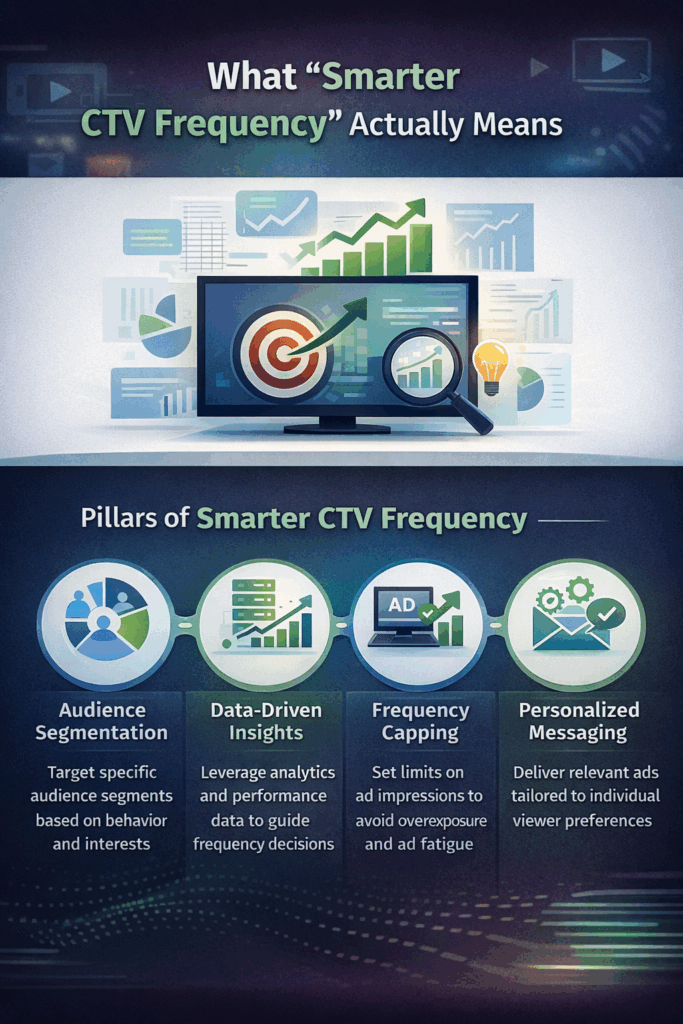
What “Smarter CTV Frequency” Actually Means
Smarter frequency in CTV is not a single setting or universal cap. It’s a strategic framework built around three principles:
1. Frequency Is a Performance Lever, Not a Guardrail
Many advertisers treat frequency caps as a safety feature. Set it once and move on.
In reality, frequency should be actively managed based on:
- Campaign objective
- The “buying stage” of your audience
- Creative length and message complexity
Upper-funnel awareness may benefit from broader reach and lower frequency. Mid-funnel consideration may require more repetition. Lower-funnel campaigns can justify higher exposure when performance supports it.
Static frequency caps ignore these vital components.
2. Household-Level Visibility Matters More Than Platform-Level Controls
Most frequency problems happen between platforms, not within them.
Platform-reported frequency often looks healthy because it reflects only that platform’s delivery. Meanwhile, the same household may be seeing the ad across multiple apps and devices.
Smarter frequency requires independent, household-level measurement that looks across the full media mix. Without it, advertisers are optimizing in silos.
This is where independent CTV oversight becomes critical.
3. Reach and Frequency Must Be Evaluated Together
High frequency is not inherently bad if reach is still growing. Low frequency is not inherently good if reach is stagnant.
Smarter streaming strategies evaluate:
- Incremental reach over time
- Frequency distribution across households
- The point where additional impressions stop driving results
Understanding when frequency turns from productive to wasteful is one of the most valuable insights in CTV optimization.
Common Frequency Traps in Streaming Campaigns
Even sophisticated advertisers fall into predictable traps when they advertise on streaming:
Relying Solely on Platform Defaults
Default frequency caps are designed to protect platforms, not advertiser outcomes. They rarely align with specific business goals.
Scaling Spend Without Re-Evaluating Exposure
As budgets increase, frequency often rises faster than reach. Without active monitoring, campaigns overserve the same households at scale.
Treating All Audiences the Same
New prospects, retargeted viewers, and high-intent audiences should not be managed with the same frequency logic.
How Smarter Frequency Improves CTV Performance
When frequency is managed intentionally, advertisers typically see:
- More efficient reach expansion
- Lower waste from excessive repetition
- Stronger performance stability over time
- Clearer insights into optimal exposure thresholds
Smarter frequency doesn’t just protect budgets. It creates room to reallocate spend toward higher-performing inventory and audiences.
The Role of Independent Measurement and Guidance
One of the biggest challenges in CTV frequency management is objectivity.
Platforms report on their own delivery. Agencies optimize within their buying lanes. Few stakeholders are incentivized to highlight overexposure across the ecosystem.
This is where independent partners like adduro.io play a critical role.
adduro.io helps advertisers:
- Understand true household-level exposure across streaming
- Identify frequency-driven waste that platforms don’t surface
- Establish performance-informed frequency benchmarks
- Adjust strategy without disrupting active buys
The goal is not to cap impressions arbitrarily. It’s to align exposure with outcomes.
Smarter Frequency Is a Competitive Advantage
As more brands advertise on streaming, inefficiencies compound. Frequency mismanagement is one of the fastest ways to lose ground without realizing it.
Advertisers who treat frequency as a strategic input, not a checkbox, gain:
- Stronger performance consistency
- Better control over reach
- More confidence in where their CTV dollars are going
In a channel defined by scale and complexity, smarter frequency is one of the clearest paths to better results.
Final Thought
CTV success is not about showing up more often. It’s about showing up enough.
Smarter frequency turns streaming from a blunt instrument into a precision channel. And for marketers who want to advertise on streaming without waste, it’s no longer optional.
Need help with your CTV campaigns? Contact us for a free platform demo and see how adduro.io can help you reach the ideal audience with the ideal message at the ideal time.